In response to India’s rising dementia burden, Christ (Deemed to be University) has partnered with the World Headache Society (WHS) to launch a five-year academic collaboration that will introduce a structured specialisation track in dementia studies within a Master’s programme in neuropsychology.
The initiative, described as the first-of-its-kind structured track in India, will be offered from the second year of the Master’s programme and is set to commence with the 2026–27 academic batch. The programme will integrate clinical exposure, guest lectures, and supervised training through the WHS Cognition and Behaviour Group, while also enabling joint research, academic supervision, and international publications.
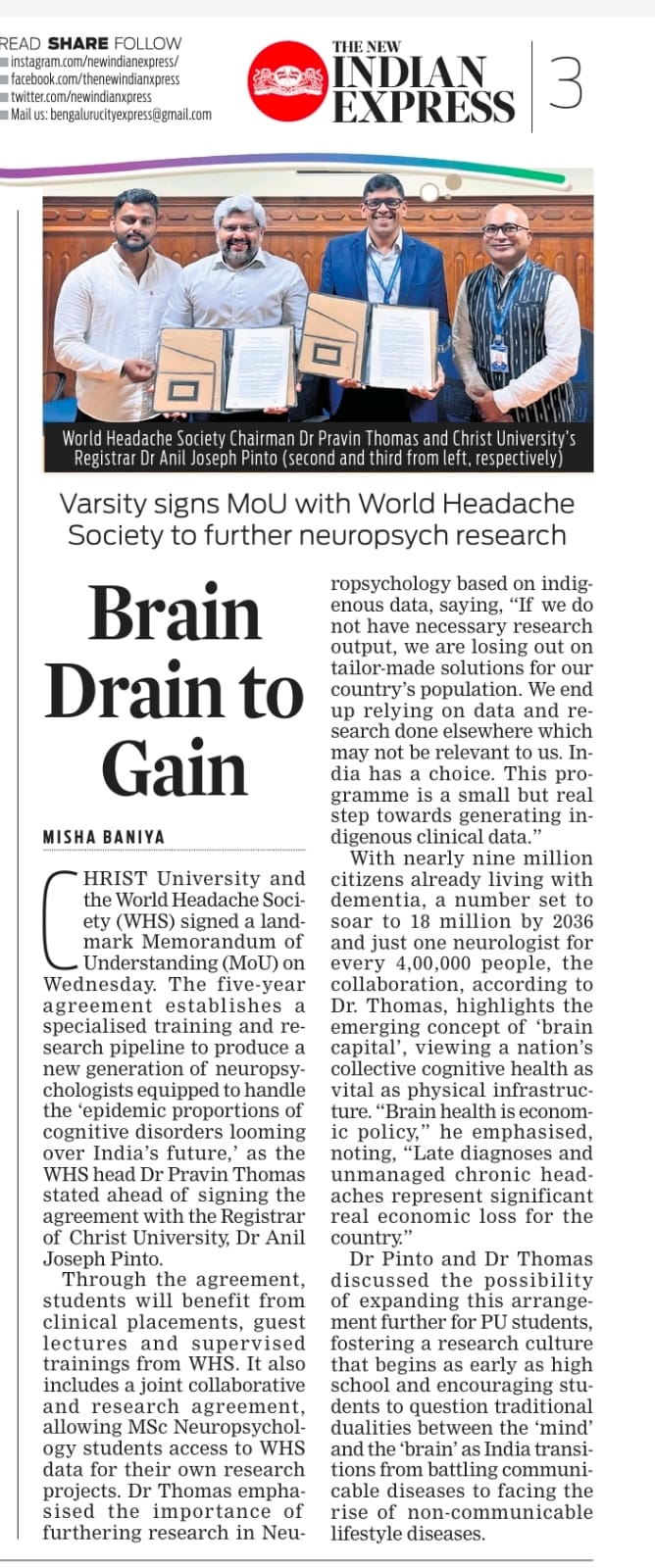
The memorandum of understanding (MoU) was signed on Wednesday by Anil Joseph Pinto, registrar of Christ, and Pravin Thomas, head of the World Headache Society in the presence of Thaddeus Alfonso representative of School of Psychological Sciences Christ University Central Campus.
The initiative is supported by Surekha Chukkali, dean of the School of Psychological Sciences; Sudhesh N.T., head of the School of Psychological Sciences, and Padmakumar P., coordinator of the Neuropsychology programme.
Dementia spectrum
Dr. Thomas said dementia in India extends well beyond Alzheimer’s disease, encompassing vascular and mixed dementias, as well as younger-onset cases that affect individuals in their 40s and 50s. He noted that frontotemporal dementia is often misdiagnosed as psychiatric illness, while autoimmune disorders and chronic neurological conditions also contribute to cognitive decline.
“Chronic migraine affects over 200 million Indians and doubles the risk of later cognitive decline, while emerging concerns such as excessive digital exposure – sometimes referred to as ‘brain rot’ – are beginning to impact younger populations,” he said.
Focus on training, research
The collaboration aims to address gaps in specialised training and research in neurocognitive disorders. Students enrolled in the programme will gain hands-on clinical experience and exposure to evolving diagnostic and therapeutic approaches, including advanced imaging, blood-based biomarkers, and disease-modifying treatments.
The partnership also seeks to build a pipeline of trained professionals equipped to identify and manage dementia at earlier stages, a critical need in India where diagnosis often comes late.
Economic and public health implications
The initiative also highlights the growing economic burden of dementia, with global costs estimated to exceed $1.3 trillion annually. In India, the impact is largely borne by families, often leading to loss of productivity as working-age individuals drop out of the workforce.
Dr. Thomas emphasised the concept of “brain capital”, describing cognitive health as a key national asset that requires sustained investment. Both institutions indicated that they would explore public-private partnerships to support research funding and student scholarships. The collaboration places Bengaluru at the forefront of emerging global developments in dementia research and care, he said.
Published – April 22, 2026 09:18 pm IST